Decarbonising homes and ending fuel poverty: The SEA’s answers to the sector’s biggest questions
Michael Williams of the Sustainable Energy Association (SEA) talks about some of the biggest barriers facing the energy transition, and their proposals to accelerate the transformation of the UK’s building stock.
The UK is making positive progress towards achieving its climate targets. Overall, emissions are now over 50% below what they were in 1990. The number of electric vehicles on UK roads has doubled in the past two years, heat pump installations increased by 56% in 2024 and renewable electricity generation is rapidly expanding.
However, latest figures show that buildings still account for 21% of the UK’s overall greenhouse gas emissions. The Climate Change Committee’s Balanced Pathway requires that all replacement heating systems must be low carbon after 2035 to ensure a fully decarbonised housing stock by 2050. Despite this, it is estimated that around 10 million fossil fuel boilers will be fitted before 2035.
Alongside this, the energy crisis continues to affect millions across the country. 11% of households in England were classed as fuel poor in 2024, and National Energy Action has estimated that up to 4.5 million households across the UK are in fuel poverty.
The SEA recognises that a holistic, whole building approach is the only way to decarbonise homes and buildings, while reducing fuel poverty, and creating warm and healthy living and working spaces fit for the future. We have launched two initiatives this year designed to do just this, unlocking greater energy efficiency demand across the UK’s building stock, while helping to reduce energy bills for consumers.
Our proposal to phase out fossil fuel heating
Early subsidy schemes designed to kickstart installations of low carbon heating systems have been successful at encouraging early adopters to make the switch from fossil fuel heating systems. So far, over 64,000 vouchers have been issued under the Boiler Upgrade Scheme (BUS), which provides support for the installation of low carbon heat pumps and biomass boilers. In the first quarter of 2025 alone, almost 12,000 heat pumps were installed as a result of various government funding programmes. We are also strongly supportive of the recent BUS proposal to expand grant funding to include technologies such as batteries, with consideration also being given to infrared and other direct electric solutions.
However, while these subsidy programmes are important to kickstart the industry, there is a need for a longer-term approach which sets us on a clear pathway to decarbonisation. European demand for heat pumps has stalled in recent months, and although the withdrawal of subsidies has driven this slowdown, without a firm regulatory backstop – such as a fixed date for phasing out boilers – subsidising a market into existence is unrealistic. As political and economic pressures mount, and grant schemes such as the BUS expand, subsidy programmes will face increasing scrutiny from the Treasury, making regulatory drivers all the more important.
The SEA has therefore developed a sensible regulatory pathway for decarbonising homes that complements ongoing subsidy schemes. It avoids favouring particular technologies and would give investors the confidence to support the innovations and infrastructure set to replace today’s fossil fuel boilers, within a stable and predictable regulatory framework.
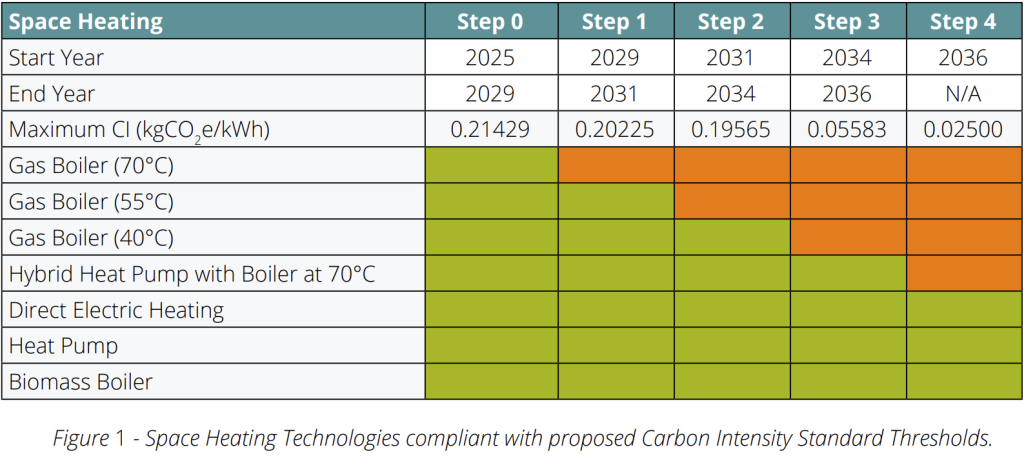
Our Carbon Intensity Standard (CIS) proposal introduces a phased approach to ending new fossil fuel heating systems, gradually lowering the carbon limit for new heating installations and major component replacements between 2029 and 2036. It promotes a market-driven, technology agnostic decarbonisation of home heating, while crucially providing long-term stability for the industry. The initiative will encourage investment in future heating technologies and infrastructure, without requiring customers with functioning fossil fuel boilers to ‘rip them out’ prematurely.
Our plan to increase the efficiency of our homes and buildings
Analysis in the English Housing Survey found that in 2024, almost 10 million households were living in ‘cold, damp, poorly insulated homes’. Furthermore, recent news showed that the mechanisms currently in place to help increase the energy efficiency of UK homes has resulted in some poor-quality installations, leading to 39 companies being suspended from installing new solid wall insulation. The SEA believes that the journey towards Net Zero should be just as much about driving an improvement in the quality of our buildings.
So far, the government’s plans for increasing the energy efficiency of UK homes and buildings has been a model of up-front grant payments to low-income households and those with the lowest Energy Performance Certificate (EPC) ratings.
The SEA’s Energy Efficiency Incentive (EEI) will instead incentivise energy bill savings by rewarding in-use performance of energy efficiency measures, driving up standards across the sector. In place of the current approach of up-front payments that feature in current retrofit programmes, the proposed incentive will implement a pay for performance incentive model. It is hoped that this would reduce instances of poor-quality installations, rewarding quality and performance.
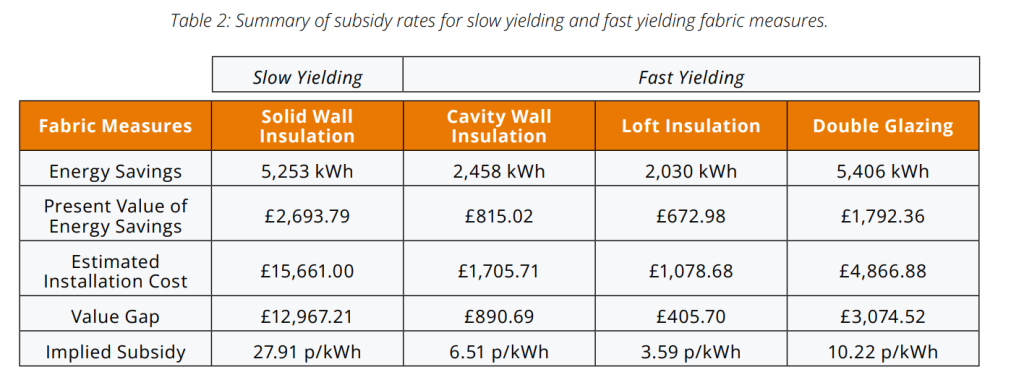
Benefits of a longer-term incentive include providing a predictable revenue stream for potential investors, while better supporting the able-to-pay sector and private-rented homes, categories largely ineligible for current schemes. The model builds upon the success of successful revenue incentives such as the introduction of feed-in-tariffs for solar PV rollout, and the offshore wind Contracts for Difference (CfD) scheme.
We believe that this initiative will provide a stable, long-term policy framework extending over 15 years while moving towards incentivising the outcome of installed efficiency measures as opposed to focusing solely on up-front costs. Technological developments such as Smart meter enabled thermal efficiency ratings (SMETERs) allows us to accurately record the performance of these measures, while other finance mechanisms can be put in place to help with up-front costs.
Our future plans
We’re currently working on some exciting analysis to help complement our drive to create greener, warmer, and healthier homes. As homes and buildings decarbonise their heating systems, electricity prices must come down to help make running costs for low carbon heating more cost-effective and encourage adoption.
Currently, energy levies are placed on electricity bills to support social and environmental initiatives, making electricity four times more expensive than gas. Current analysis also finds that fuel poor households are more likely to rely on electricity as the fuel for their main heating system, driving up energy prices and exacerbating fuel poverty.
The government have been considering their options for redistributing energy levies, in a way that avoids increasing energy bills for the majority of households in the short to medium term. The SEA are currently modelling scenarios to explore the impact on running costs, lifetime costs, how this varies for different technologies, and depending on how the government chooses to redistribute levy costs.
If you want your voice to be heard by the key decision makers and be a part of our policy development this year, join us now by visiting our website.
The Sustainable Energy Association will be speaking at elementalLONDON about the policy landscape for low carbon heating, cooling and energy on 20 November. To register for your free ticket, click here.