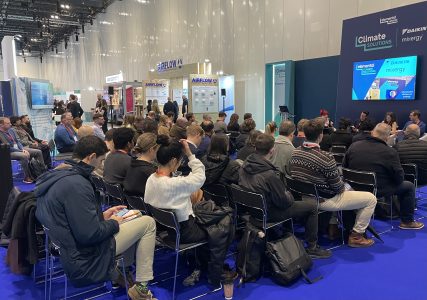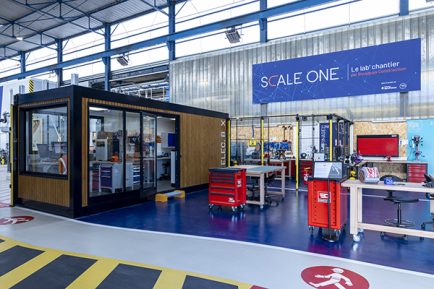
Inauguration de Scale One, Bouygues Construction. Chilly-Mazarin. 06 octobre 2026. © Laurent Guichardon.
Scale One is a mock construction site 30 minutes south of Paris, giving manufacturers, start-ups and contractors somewhere to find out what products are like to install before they reach a real job.
The idea behind this “simulated job site for innovators”, according to the site’s boss, Damien Bahon, head of Scale One, is simple: a real site cannot afford failure, so a new technology has to work first time. At Scale One, a poor result is simply information on how to improve the product. “It’s sort of a crash test area, but without the issues of failing,” Damien says.
The site combines space, raw materials, construction equipment and, importantly, frontline workers. Workers with years of experience in the construction industry who can put new products, or methods of working, to the test without compromising an actual building site.
Scale One is publicly funded by the Paris region and the French government – under the France 2030 strategic plan – and is open to the wider industry rather than serving Bouygues Construction alone. Any supplier or manufacturer who has a solution they want tested by true experts under real-world conditions can get involved, with essential feedback on what does, and doesn’t work, from an installation perspective.
What is on site at Scale One
There are two simulated sites. One, has four test beds with a mobile crane and tests construction processes for new-build work. The other is a metal structure representing a two-storey building, set up as a renovation test bench with a facade of around 10 metres high. Damien says it was built because of strong market demand across Europe, including the UK and Switzerland, for facade renovation.
There is also the FabLab, which has a 3D printer and CNC equipment so teams can quickly design and prototype the tools and components that innovators realise they are missing once they reach the test bench.
There is a further 3D printer, for concrete, specifically for open research into how concrete is placed on site, plus a training centre for robotics. A visitor centre made of modular cabins, hosts groups of up to 30, receiving up to five visits a week, with about 30% of visitors from abroad and around 40% from outside construction.
The focus is installation, not performance
Scale One is not a laboratory testing the performance of construction materials or methods, Damien says, explaining that it does not run stress tests or certify performance of products once a building is complete. What it offers is access to the site, installation by Bouygues Construction teams, and data on how long a product takes a normal worker to fit, along with the workers’ own feedback as the eventual users. Damien points out that price is driven by both the material and the installation time, so a product that is awkward to fit can lose its market advantage.
Examples from the first projects include:
- Saint-Gobain tested how a facade panel designed to take solar cells could be fitted, covering handling, scaffolding needs and time to clad a whole facade.
- A car-industry fixings maker moving into construction tested a facade panel system to check whether installation productivity met market needs.
- Hilti compared a conventional screw-fixed method for assembling timber panels with its new clip-together approach. Two experienced workers assembled, dismantled and reassembled three panels each way.
- Drilling machines: a worker with 20 years’ experience tested six different drills, some with exoskeletons, wearing sensors to compare the strain on his body, alongside his own preferences.
- Wood dust: Bouygues Construction’ wood construction health and safety department commissioned tests of vacuum extraction methods, as wood dust is a growing concern in the EU.
- Low-carbon concrete: the team assesses new concrete mixes and aggregates at sample, wall and tiny-house scale, working with cement and aggregate manufacturers including Ecocem.
- Sizewell C: a mock-up tested how to connect precast walls and slabs, with people from the project invited to see it.
- Toulouse metro: after tests at Scale One, Bouygues Travaux Publics (civil works) improved its method for forming voids in a 2-metre-thick slab, and the improved method was used on the real project.
Robots to assist, not replace
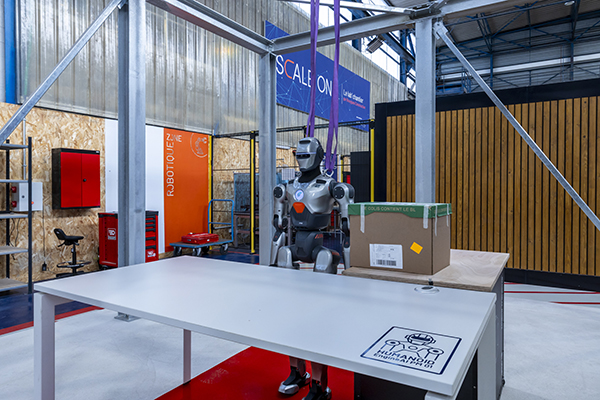
The most eye-catching test involves a humanoid robot controlling traffic at a site entrance, a dangerous job Damien says nobody wants. He puts a human marshal at around €100,000 a year per project in France, against a robot costing around $20,000 over five years. Early trials of recognising trucks and pedestrians showed what he calls huge potential.
His site superintendent’s first feedback was that the robot must wear a helmet, so the team designed one to fit the robot’s sensors and added a hi-vis jacket. Damien says it sounds silly but matters: workers’ views on safety and deployment have to be heard. The goal, he stresses, is to assist workers, cutting physical strain and making the job more attractive to young people, never to replace them.
 Inauguration de Scale One, Bouygues Construction. Chilly-Mazarin. 06 octobre 2026. © Laurent Guichardon.
Who is coming, and why
Overseas visitors are mainly from North America and Asia, particularly Hong Kong and Singapore, with some from the UK’s Hinkley Point C and Sizewell C supply chains. Damien says they come for two reasons. Europe is where demand for low-carbon materials is strongest, and he believes North America and Asia are five to ten years ahead of Europe on construction robotics. Both groups want a place to land in Europe, and he is exploring an assessment centre for robots.
How it works and what comes next
A team of 12, mostly engineers and designers, runs the site, with a smaller crew preparing each test using the manufacturer’s draft instructions. Workers join from live Bouygues Construction projects for one to three months, giving four or five different teams a year, chosen by specialism. The Sizewell mock-up used civil works teams rather than standard formwork crews.
The target is around 100 projects a year, from one-day drill tests to four-month mock-ups. Damien says the aim is one third of clients from outside Bouygues Construction, one third from within, and one third collaborative industry-wide projects with public or private sponsors, with EU research funding in mind.
For more information, visit: bouygues-construction.com/en/values/innovative-spirit/experimentation
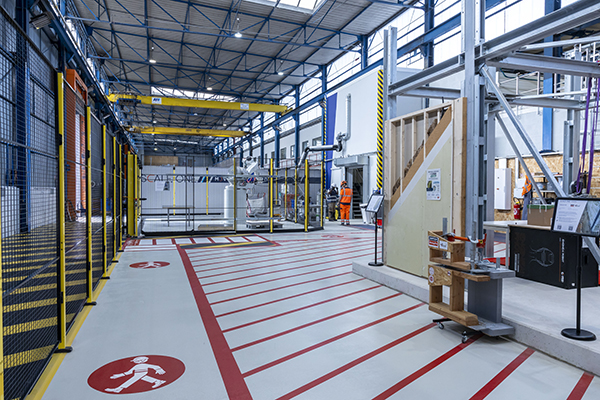 Inauguration de Scale One, Bouygues Construction. Chilly-Mazarin. 06 octobre 2026. © Laurent Guichardon.