Spotlight on: data centre cooling with Oliver Sanders of Carrier UK&I
elementalONLINE Editor Joe Dart speaks to Oliver Sanders, Data Centre Commercial Director – Carrier UK&I, about Carrier UK’s role in the fast-changing data centre cooling market.
Q: What solutions do Carrier provide for data centres?
A: Our main route to market is through chillers, through CRAH (Computer Room Air Handling) units, through CDUs (Coolant Distribution Units). But the main point of why Carrier is here and the message we want to portray is that we’ve got this suite of offerings, which we’re calling Carrier QuantumLeap.
We have a framework for integration, instead of just selling a product, we’re selling the whole life cycle management.
Data centres aren’t just big buildings with air conditioning anymore. They’re quite complex thermal power plants. There’s a lot of opportunity in that market with heat recovery or looking at other energy efficient solutions.
Q: Why is liquid cooling so important for data centres?
A: There’s a lot of new chips in the market which operate at elevated temperatures. There’s even people saying that chillers aren’t needed in the market. But, really, when you look at it, pure liquid cooling, it’s a myth.
Say you’ve got liquid cooling on a 100 kW rack, you’ve got 80% of that as liquid cooling, but 20% of that is still going to be air cooled. What’s going to cool your networking? What’s going to cool your power supplies? So, as the densities increase and the rack densities increase, that capacity’s only going to improve or get bigger.
There’s always going to be an element of air-cooled. We provide both solutions, we have large dry air coolers from chillers, CDUs and the CRAH units.
Q: What are the biggest challenges your data centre clients are facing currently?
A: For data centre clients; planning, power. It’s always going to be something. So, we’re looking at how to improve PUEs (power usage effectiveness) as much as possible, but also trying to look at different solutions. If people are having trouble with planning, are having trouble with power, how can we look at heat recovery solutions, for example.
If a data centre’s getting bad press for being built in a certain area, why don’t we give some heat into the residential areas or the industrial processes, and things like that. The technology’s there, it’s relatively simple to utilise that waste here.
Q: What are some of the latest advancements in data centre cooling?
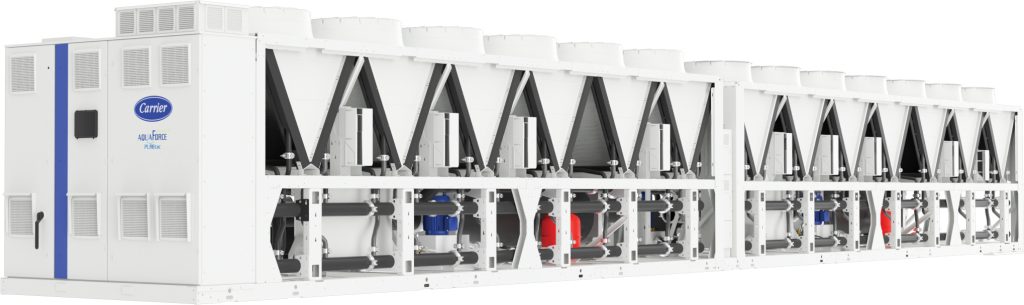
A: We have what’s called ‘free boost’ technology within our Carrier 30XF chillers. These are air-cooled, total free cooling machines. They look at a very high energy efficiency. Using smart cooling, they can consider at what temperature they can achieve 100% free cooling. If you’re looking at just glowing fans, the power input is actually quite high. What we at Carrier do is, at a certain ambience, we bring the compressor in a little bit, which is actually more energy efficient than just running the fans. When we do that, your energy efficiencies go sky high.
Q: What advice would you give to a data centre operator about what to consider for their cooling needs?
A: Engage early, it’s not going down a legacy design. When you look at data centres, when you look at AI; AI is a calculation into heat essentially. The heat is the byproduct of what we’re looking at here. So, we need to understand where that heat goes. We need to have a look at the geography of where that data centre is and where the heat can go.
You’ll hit a thermal wall with certain solutions such as dry air cooling. We’ve got dry air cooling, we’ve got evaporative cooling, we’ve got heat recovery, or just a large body of water. We call them the four destinations. There’s no magical fifth destination, but it is a case of understanding, instead of maybe designing from the chip forward, designing from the destination backwards and then you’ll really get the most efficiency out of the systems.
Q: What support do you offer clients once systems are installed?
A: Carrier’s QuantumLeap offering isn’t just selling the equipment, it’s the full life cycle of the product. So, when you look at our service divisions, at our rental divisions; any critical failures or anything like that, we have a rental team that can support it. We’ve got the service team, around 650 engineers across Europe that are ready to support our data centres.
Q: How do you see the data centre market changing in the next five years?
A: Trajectory is a moving target, but you can only see it going one way and that’s up. Recently we’ve seen a surge in enquiries and projects that have been worked on for a long time going ahead. It’s such an exciting market to be in at the moment, there’s a real buzz.