
Greg Brushett, Sales Director at Adveco, provides insight on common issues facing commercial specifiers when it comes to heating and hot water, and explains how the market is set to evolve over the coming years.
Q: Can you provide me with a brief overview of what Adveco does?
A: Adveco is the UK’s specialist provider of low-carbon hot water systems to the building services industry. The company designs, supplies, commissions and provides manufacturer grade service of domestic hot water (DHW) systems for commercial and public sector buildings.
For more than 50 years Adveco has led innovation in gas water heating, and more recently in award-winning low carbon applications that leverage heat pumps, solar thermal and electric water heating to help support Net Zero strategies.
Q: What current trends are you seeing in the market and from your customers?
A: Although demand is slightly decreasing, gas-fired systems remain a major function throughout the retrofit space. Lack of funding, uncertainty over new technologies and the relative cost of gas versus electricity means we still see a desire for like-for-like replacement, especially where there is high daily DHW demand.
For newbuilds, there are no new gas connections, so the trend is all about electric and heat pumps to help the building get through Part L. The easiest perceived way to achieve this is to select CO₂ heat pumps and add some photovoltaics (PV) for low-cost electrical energy. The problem is that consultants/contractors are struggling to make this work when keeping return temperatures below 30°C.
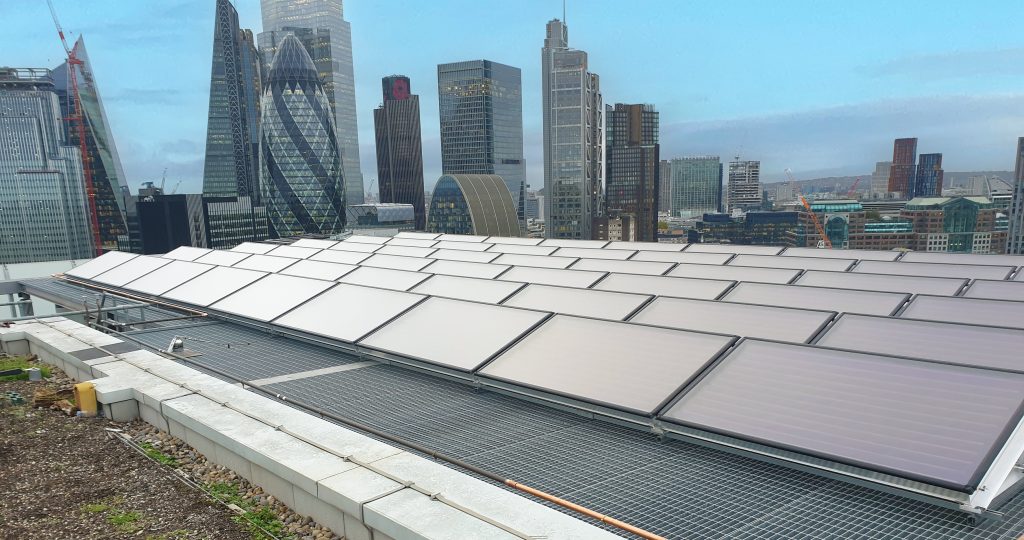
Should the return temperature get too high, the coefficient of performance (COP) drops exponentially, and the unit eventually just shuts off. PV is also far less efficient when it comes to heating water, requiring a greater area of collector at a much higher cost than solar thermal, a technology which, unlike PV, is also intrinsically safe.
This is driving the popularity of R290 heat pump systems. But there remain serious questions, as raised by BESA, over the use of larger amounts of propane required in heat pumps, their safe storage, transportation, and distance from potential ignition sources should there be a leak. This sets concerns over where current heat pump technology for commercial DHW projects needs to go, especially with the expected EU ban on R32 and other HFC-based refrigerants.
From Adveco’s perspective, we will continue to advocate hybrid electric/R32 heat pump systems for the time being and recommend solar thermal wherever possible as the best means for reducing energy, emissions and costs associated with the provision of DHW.

Q: What do your technical teams get most commonly asked about?
A: The steepest learning curve currently in the industry is understanding how to size electric hot water systems with heat pumps to accurately fulfil a building’s DHW demands. Most questions revolve around their efficient ASHP operation, space for the tank and, of course, costs.
One issue we increasingly encounter in the retrofit space is the request to switch from gas to a like-for-like electric system. A 360 kW gas application is very different to a 360 kW electrical application; the demand is simply enormous. Bringing that additional electrical supply to the building is incredibly expensive, so a lot of our technical design relates to meeting specified DHW demands whilst reducing costly electrical supply which has the potential to derail sustainability projects.
Q: Can you give me an overview of how you work with specifiers?
A: An initial engagement often happens via our free CPD offerings. Working together, we will supply the hot water design, which could involve metering an existing building or working within the specification and building legislations. The resultant design will recommend products that Adveco selects and supplies. But we can also create elements for a wider specification, such as designing only the pre-heat for a system.
Once the specification goes out to tender it becomes a case of just keeping in touch over the months should there be any updates to the specification that require addressing. Adveco does continue to be involved with the building though, through the commissioning process and ongoing system service.
Q: What upcoming regulation/technical changes do specifiers need to be aware of in the short to medium term?
A: The Buildings Safety Act has increased scrutiny of hot water systems, which higher-risk buildings (HRBs) must adhere to more strictly. For new HRBs or significant alterations to existing ones, building control approval is required. This process involves detailed scrutiny of the proposed hot water system design, ensuring it complies with regulations and safety standards.
Of note are the requirements placed on gas water heating and the installation of flues or appliance ventilation ducts which, if they penetrate compartment walls or floors should exhibit a fire resistance (REI) that is at least half of the compartment wall or floor. For all buildings over 30 m tall, and for some situations in buildings over 18 m tall or under 10 m deep, flue through compartment walls will not be allowed under the new legislation.
The will likely be further tightening of energy performance standards for hot water systems under Part L. If that is the case we can expect to see more stringent minimum efficiency requirements for all hot water systems, including boilers, heat pumps, and solar thermal systems. Regulations are also likely to incentivise greater integration of renewable energy sources, particularly solar thermal and heat pumps.
Lowering the storage temperature limits of DHW is also under review, but our technical consensus is that the review will not change the legislation. If it does, we would still design preheat at +50°C and system temperatures at a safe +65°C.
Q: How do you see the commercial heating market evolving in the coming years?
A: We expect gas to remain an option until the mid to late 2030s for retrofit purposes, with an expectation that hydrogen blends and then full hydrogen-based applications will be applicable for industrial and larger commercial projects. This will develop in tandem with heat pumps as work continues to identify safe-to-use refrigerants with a low to zero global warming potential (GWP). In the interim we expect heat pumps to continue to be best applied supplying system preheat with top-up provided by electric boilers. There is also a strong urge to employ solar thermal for pre- or mid-heat in more complex systems.
The use of offsite construction to accelerate project workflow and secure high-quality manufacture/installation will continue to grow, and we see it as an increasingly popular choice for securing dedicated roof-based DHW plant rooms for commercial projects.
We also see the value of increased intelligence, with smart controls, onboard water, and energy metering offering improved energy management, service and maintenance scheduling, and evasion of critical failures. This all helps to reduce emissions, capital and operational investments and prolongs the lifespan of DHW systems.
About Greg Brushett, Sales Director, Adveco
Greg brings more than 15 years of sales and engineering expertise in the commercial heating and hot water industry. He originally joined Adveco in 2011 as a sales engineer, moving to Viessmann in 2014 in the role of area Business Manager (commercial & renewables).
Returning to Adveco, Greg was promoted to role of Sales Director following a programme to expand the business into new commercial markets with award-winning success for its innovation and dedication to supporting customers’ sustainability strategies for hot water.