

Credit: Clare Louise Jackson/Shutterstock
Everything you need to know about the Warm Homes Plan
The long-awaited Warm Homes Plan has been released. In this article, we run through everything we know about this vital upgrade scheme for UK homes.
First touted in 2024, the Warm Homes Plan (WHP) has finally been launched, promising £15 billion of funding to upgrade homes, lower energy bills, mitigate climate risks and guard against global energy volatility. Here’s everything we know so far.
The aims of the Warm Homes Plan
The government has set the following targets for the WHP to deliver by 2030:
- Lift one million families out of fuel poverty and tackle long-term energy costs. This follows the government’s intervention to take an average of £150 of costs off energy bills for all families this April.
- Lift half a million families in rented accommodation out of fuel poverty.
- Upgrade five million homes with renewable energy technologies and retrofit measures.
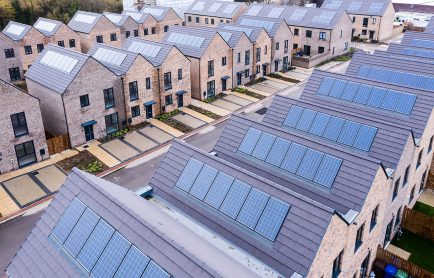
- Triple the number of homes with rooftop solar panels, in what the government calls a ‘rooftop revolution’.
- Ensure at least 70% of heat pumps installed in the UK are made in the UK.
- Deliver energy security by reducing reliance on volatile international fossil fuel markets.
It is hoped the plan will unlock an additional £38 billion in investments by industry in innovation, UK based manufacturing, upskilling and training, and will create “180,000 additional high-quality, well-paid, future-proofed jobs in energy efficiency and clean heating”.
Three pillars of the Warm Homes Plan
The WHP is built on three key measures.
- Support for low-income households
Low-income households will receive free-of-charge upgrades based on the technologies most suitable for their homes, such as solar panels and batteries. For social housing residents, this could mean upgrades to entire streets at the same time, lowering bills and improving warmth and comfort for whole neighbourhoods.
According to the government’s own reporting, there are currently over 1.5 million homes across the UK fitted with solar panels, saving a typical household an average of £350 a year on energy bills. Analysis from E3G suggests heat pumps could halve heating bills compared to a gas boiler. When combined with solar panels, the results could be financially life changing for low-income households. According to the government’s own reporting there were an estimated 2.73 million households (11% of homes) in fuel poverty in England in 2024.
- Low-cost loans for renewables
The WHP includes nearly £2 billion in funding to support low-interest loans for all consumers, making energy-bill reducing measures such as solar, batteries and heat pumps more affordable to ordinary households. These loans can be linked to the existing Boiler Upgrade Scheme, which provides a £7,500 universal grant for heat pumps.
Recent polling found that over 35% of people can’t afford the upfront cost of upgrading their homes’ energy efficiency. However, a typical household investing in home upgrades under the plan could save as much as £1,000 on its annual energy bill, according to figures from the research and innovation charity Nesta. The charity found that households that get a heat pump, solar panels and a battery could reduce their yearly bill from April from about £1,670 to about £670 under the changes brought in by the plan.
The Department for Energy Security and Net Zero (DESNZ) will set out further details of the scheme’s eligibility later this year, with the scheme then expected to roll out in phases.
- Minimum energy efficiency standards for rental properties
The plan confirms Labour’s manifesto pledge to raise minimum energy efficiency standards for the rental sector. This means that the majority of rental properties will need to have a minimum EPC C rating by 2030. This is expected to benefit over 1.5 million rental households, saving renters £300 in energy bills and reducing cases of mould and damp.
How will the Warm Homes Plan funding be allocated?
The plan includes five schemes in England:
- £5 billion for upgrades, including insulation, solar panels, batteries and heat pumps, for people on low incomes.
- £2 billion towards low-cost loans for people who can afford them.
- £2.7 billion for the Boiler Upgrade Scheme.
- £1.1 billion for heat networks.
- £2.7 billion towards ‘innovative finance’ through the Warm Homes Fund, which could include schemes such as green mortgages offering a lower interest rate to homes that have been insulated and equipped with solar panels and heat pumps.
There is also £1.5 billion in other funding for WHP programmes within devolved administrations in Scotland, Wales and Northern Ireland.
What’s happening with boilers under the Warm Homes Plan?
Originating under the previous government, the longstanding pledge to ban gas boilers beyond 2035 has quietly been dropped, and there’s now no phase-out date for gas boilers despite the government’s plan to wean the UK off fossil fuels.
Instead, billions of pounds will go towards heat pump installations, and under the WHP air-to-air pumps will also be included in the Boiler Upgrade Scheme.
However, the government has reduced its target to install 600,000 heat pumps a year by 2030 to 450,000.
How will the Warm Homes Plan be delivered?
The government plans to form a new Warm Homes Agency (WHA), which will “reverse the inherited situation where there is a fragmented and overly complex system to navigate for energy efficiency upgrades ensuring consumers have access to quality installations, from initial advice to installation”.
Subject to agreement with the devolved governments, the WHA will work at both a national level across the UK and at a local level. Salix (an existing non-departmental public body) will close and its functions, alongside some from within DESNZ and relevant roles in Ofgem, will be brought together into a single executive agency.
The government says a ‘strong data and intelligence function’ will underpin the WHA’s operations, which will harness artificial intelligence and advanced analytics to assess market trends, identify delivery bottlenecks, and optimise the scheme’s performance. However, no time scales have yet been given for the deployment of these solutions.
The government also says the WHP puts local mayors in the driving seat for rolling out home upgrades in their area, and says it will support local leaders to deliver on behalf of their residents.
The chief concern, however, is whether the UK has the skills and staff to deliver on the WHP’s promises. It was previously thought that the plan would focus on ramping up insulation in homes, which is considered a cost-effective way to reduce heat loss from the UK’s leaky housing stock. However, the previous government-funded insulation scheme, ECO, is widely regarded as a failure, with the National Audit Office finding 98% of homes with external wall insulation installed under the government’s ECO4 scheme required work to correct major issues that will cause problems such as damp and mould.
While some of the schemes are already distributing grants, it’s not yet clear how or when new funding will be delivered. The government said that “further engagement with the finance sector” is needed this year.
How has the Warm Homes Plan been received?
The WHP has been largely welcomed by those in housing, energy and local government. Greg Jackson, Founder of Octopus Energy called it a “really important step forward”, while Cllr Arooj Shah, Chair of the Local Government Association’s Neighbourhoods Committee, said that councils are “pleased to see significant investment” behind measures tackling cold, damp homes.
Meanwhile, Sara Edmonds, Co-Director of the National Retrofit Hub, said the hub “welcomes the government’s Warm Homes Plan as an opportunity to expand the definition of success in retrofit, focusing on the real impact retrofit has on people’s lives”.
However, others have criticised the plan for not going far enough. Speaking to The Guardian, Mike Childs, Head of Policy at Friends of the Earth, said that the incentives are “currently too weak”, while Jess Ralston, Head of Energy at the Energy and Climate Intelligence Unit thinktank, said the government needs to prioritise the move away from gas boilers: “The government may prefer carrots now but at some point, a stick might be a more effective tool to ensure we’re not ever more reliant on foreign gas supplies.” Further opinion on the Warm Homes Plan can be found here.


